Introduction
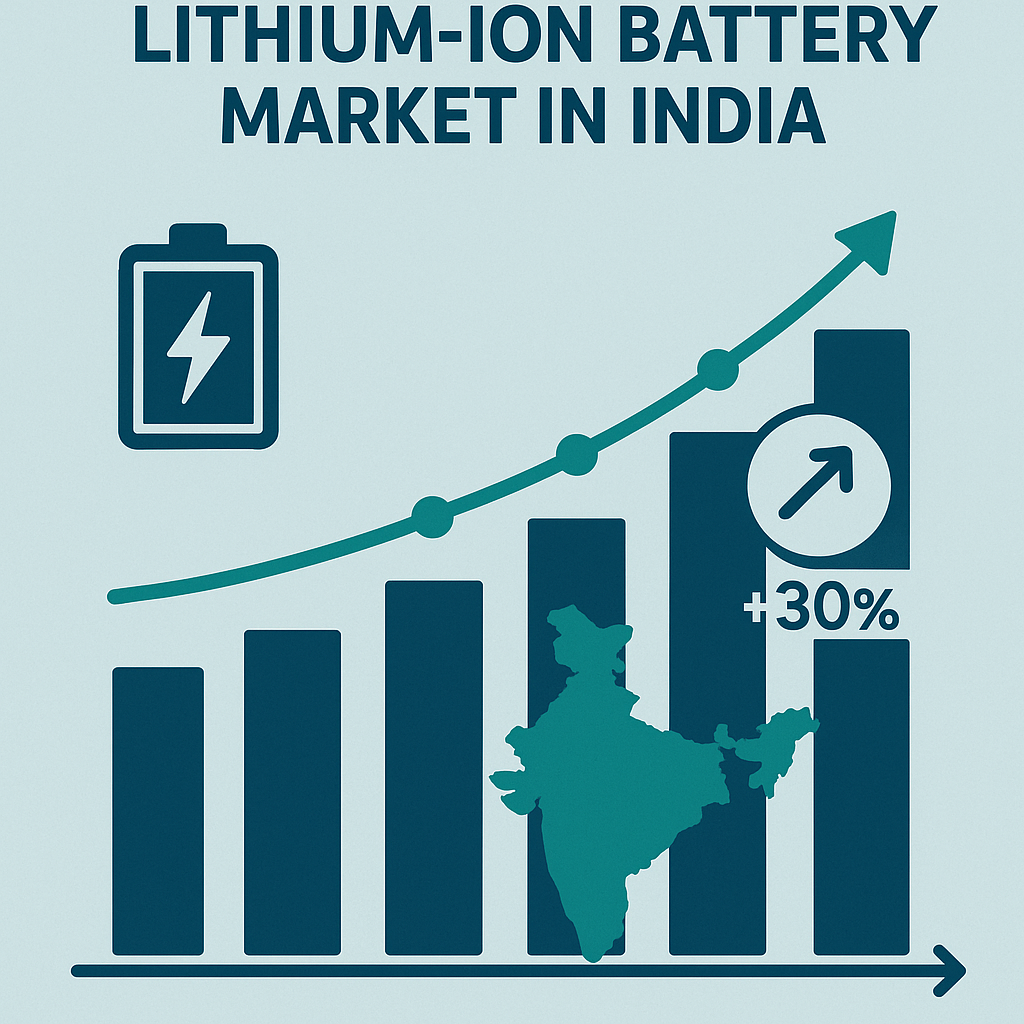
Lithium-ion battery market in India is experiencing unprecedented growth, fueled by the rapid expansion of electric vehicles (EVs), solar energy storage, and consumer electronics. This surge is supported by government policies, rising environmental awareness, and India’s broader push for clean energy solutions. As the nation accelerates its transition to sustainable power systems, lithium-ion batteries are becoming a cornerstone of India’s clean energy revolution.
Key Sectors Driving Lithium-Ion Battery Demand in India
1. Electric Vehicles (EVs)
Lithium-ion batteries are pivotal to India’s electric mobility mission. Battery-powered vehicles—ranging from two-wheelers to electric buses—depend on high-energy-density battery packs for performance, efficiency, and extended range. With EV sales in India projected to grow at a compound annual growth rate (CAGR) of over 49.2% in 2023 alone, Li-ion batteries are fundamental to enabling low-emission transport.
2. Solar Energy Storage
India has significantly expanded its solar power generation capacity. Lithium-ion batteries are indispensable in storing excess solar energy generated during the day, ensuring a stable and continuous power supply during non-productive hours (nighttime or cloudy conditions). Residential rooftop installations, commercial buildings, and utility-scale solar farms are increasingly deploying Li-ion-based Energy Storage Systems (ESS).
3. Consumer Electronics
From smartphones, tablets, and laptops to smartwatches and wearables, Li-ion batteries are the standard due to their high energy density, compact form factor, and long cycle life. With India’s booming electronics market, the demand for lithium cells continues to rise rapidly.
4. Industrial and Telecom Applications
Telecom towers, data centers, and industrial automation systems rely on Li-ion batteries for backup power. Their compactness, fast charging, and longer lifespan compared to lead-acid batteries make them ideal for mission-critical applications where uptime is essential.
Factors Fueling Market Growth
- Government Policy and Incentives:
India has launched various policy measures to boost domestic battery production and electric mobility. Key schemes include:- FAME II (Faster Adoption and Manufacturing of Hybrid & Electric Vehicles)
- PLI (Production-Linked Incentive) Scheme for Advanced Chemistry Cells (ACC)
These initiatives aim to lower import dependency, incentivize battery manufacturing, and promote the EV ecosystem.
- Declining Battery Prices:
Global battery costs have dropped by over 85% in the last decade due to economies of scale, technological improvements, and heightened competition. In India, the average cost of Li-ion battery packs currently ranges from ₹15,000 to ₹20,000 per kWh (as of 2024), depending on battery chemistry and production volume. - Growing Environmental Awareness:
Rising awareness of climate change, air pollution, and fossil fuel depletion is encouraging the shift toward electric mobility and renewable energy solutions—both of which depend heavily on Li-ion batteries.
Major Challenges Hindering Lithium-ion battery market in India
1. Raw Material Dependency
India imports the majority of its lithium, cobalt, and nickel—key inputs for battery cells—from countries such as China, Australia, Chile, and the Democratic Republic of Congo. This import dependency exposes the industry to geopolitical risks, price fluctuations, and supply chain disruptions.
2. Limited Cell Manufacturing Capabilities
While India has made significant progress in assembling battery packs, cell manufacturing remains limited. Developing a domestic cell manufacturing base is critical to building a self-reliant battery ecosystem.
3. Underdeveloped Recycling Infrastructure
India’s Li-ion battery recycling ecosystem is in its early stages. There is an urgent need for investments in recycling plants, regulatory enforcement, and closed-loop systems to manage end-of-life batteries and recover valuable metals like lithium, cobalt, and manganese.
Government Policies and Strategic Initiatives
India has taken several strategic steps to build a robust lithium-ion battery ecosystem:
- PLI Scheme for Advanced Chemistry Cells (ACC):
With a financial outlay of ₹18,100 crore (~$2.5 billion), this scheme targets the creation of 50 GWh of domestic cell manufacturing capacity by 2030. An additional 10 GWh is expected in future phases. - FAME India Scheme (FAME II):
A ₹10,000 crore (~$1.4 billion) initiative providing demand-side incentives for EV adoption and infrastructure development. - PLI Scheme for Automobile and Auto Components:
With an outlay of ₹57,042 crore (~$7.8 billion), this scheme supports the manufacturing of EVs, hydrogen-powered vehicles, and high-tech auto components. - Khanij Bidesh India Limited (KABIL):
A joint venture between NALCO, HCL, and MECL, KABIL is tasked with securing long-term supplies of strategic minerals like lithium and cobalt by investing in overseas mining assets, including those in Argentina, Bolivia, and Australia. - Battery Waste Management Rules, 2022:
These regulations impose Extended Producer Responsibility (EPR), mandating that manufacturers collect, recycle, and repurpose used batteries through certified recyclers.
Cost Analysis of Lithium-Ion Batteries in India
- EV Battery Packs:
Depending on chemistry (LFP, NMC, or LTO), electric vehicle battery packs cost between ₹15,000 to ₹30,000 per kWh. For instance, a 40 kWh EV battery may cost around ₹6–₹8 lakh (~$7,000–$9,500). - UPS/Inverter Batteries:
Lithium-based inverter batteries (12V 80Ah or ~1 kWh) for residential use are priced around ₹15,000–₹17,000. - Battery Replacement:
Replacing a Li-ion EV battery may cost ₹3–₹8 lakh, often accounting for up to 50% of the vehicle’s total value. - Other Costs:
Additional expenses include Battery Management Systems (BMS), thermal management systems, installation, and recycling/disposal.
Strategies to Reduce Battery Costs and Import Dependency
India aims to reduce its battery import dependency from 70% to 20% by FY2027. Measures include:
- Gigafactory Investments:
Scaling domestic cell production through PLI-backed gigafactory setups by players like Ola Electric, Reliance, and Rajesh Exports. - Input Duty Exemptions:
Reduction or exemption of customs duties on lithium, cobalt, nickel, and other critical battery inputs. - Alternative Chemistries:
R&D into sodium-ion, solid-state, zinc-air, and iron-based chemistries for lower-cost, safer, and more sustainable alternatives. - Battery Second-Life Use:
Utilizing used EV batteries in stationary applications such as home ESS and telecom towers to maximize utility and reduce waste. - Localized BMS & Thermal Systems:
Developing indigenous battery management and thermal regulation systems suitable for Indian climate and grid conditions.
Environmental and Circular Economy Outlook
While Li-ion batteries play a critical role in reducing emissions during their use, their manufacturing process is resource-intensive. To mitigate environmental impact:
- Battery Recycling:
India’s battery recycling market is projected to grow at a CAGR of 20.45% through 2030. Recycling ensures recovery of scarce metals and reduces dependency on mining. - Second-Life Applications:
Used EV batteries can be repurposed for non-automotive uses such as grid storage, commercial UPS systems, and residential energy backups, extending battery life cycles and supporting circular economy models.
Key Industry Players and Their Initiatives
Ola Electric
- Planning to invest $1 billion in an ACC gigafactory.
- Targets 50 GWh cell production capacity by 2027 to meet internal EV manufacturing needs.
- Currently importing cells from South Korea but collaborating with global suppliers like Dürr, Siemens, and StoreDot (Israel) to bring cutting-edge battery tech to India.
Reliance Industries
- Acquired Lithium Werks (LFP technology) and Faradion (sodium-ion technology).
- Partnered with Ambri (U.S.) to build a large-scale battery facility in India.
- Plans ₹150 billion investment across the battery value chain.
Rajesh Exports
- Selected under the PLI ACC scheme and is setting up infrastructure for advanced battery cell production.
Other Entrants
- Companies such as Mahindra, Tata Chemicals, India Power, L&T, and Thermax are exploring opportunities in pack manufacturing and, in some cases, cell production.
Lithium Reserves in Jammu & Kashmir: A Game-Changer
In 2023, the Geological Survey of India (GSI) confirmed the presence of approximately 5.9 million tonnes of inferred lithium reserves in the Salal-Haimna area of Reasi district, Jammu & Kashmir. This discovery could be transformative:
- Benefits:
- Reduces import dependency on lithium.
- Spurs local job creation and industrial development.
- Encourages vertical integration of the battery value chain.
- Supports the development of Special Economic Zones (SEZs) and processing units.
Conclusion: India’s Battery-Powered Future
Lithium-ion battery market in India is poised for explosive growth, expected to reach $80 billion by 2030 (India Energy Storage Alliance). Demand will be driven by:
- Mass EV adoption.
- Renewable energy storage solutions.
- Digital infrastructure expansion.
To realize this potential, India must strategically invest in domestic manufacturing, secure raw material access, promote recycling, and foster innovation in battery chemistries and design.
With robust policy backing, proactive private-sector participation, and international collaborations, India is well-positioned to emerge as a global hub for lithium-ion battery innovation, manufacturing, and sustainability.
Nice post. I learn something more challenging on different blogs everyday. It will always be stimulating to read content from other writers and practice a little something from their store. I’d prefer to use some with the content on my blog whether you don’t mind. Natually I’ll give you a link on your web blog. Thanks for sharing.
Thank You